
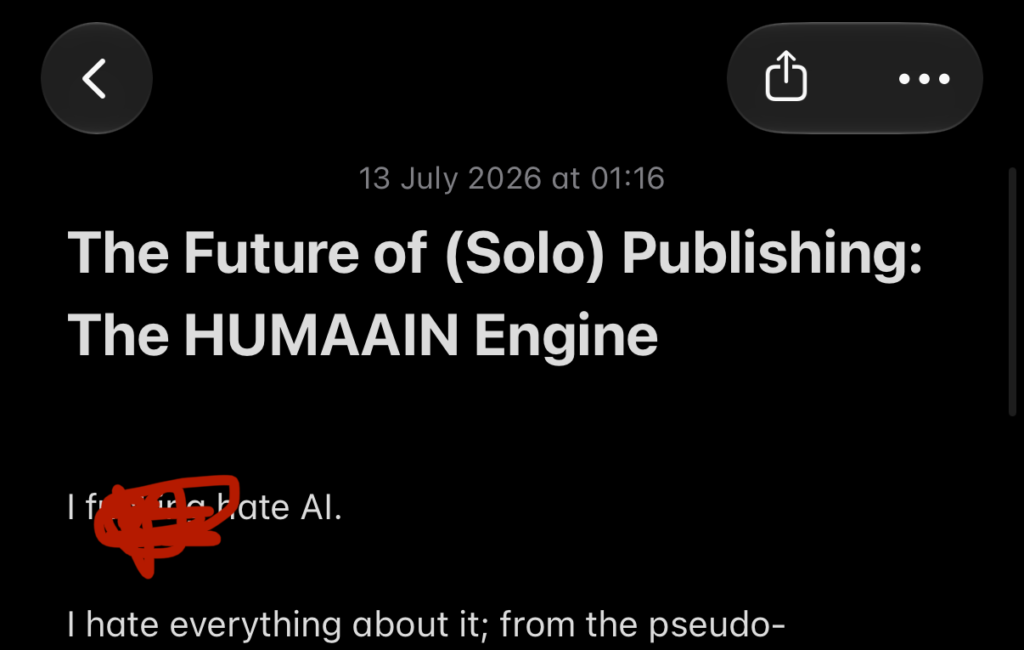
I f¢K#ing hate AI.
I hate everything about it. From the pseudo-intellectual affectation to the confident misinformation. AI doesn’t stand for artificial intelligence, it stands for artificially inflated. But this, and every article moving forward, will be published via what I believe is the first truly “AI-native” publishing platform.
Decoupling AI From LLMs
The technology underlying the marketable term “AI” is remarkable, despite producing unremarkable results. I think it was broken from how it was developed; as a tech tool first, not one with creatives in mind.
After LLMs were good enough to do real code, the idea that “AI is democratising creativity” soon took hold because creativity is a skill not a lot of AI consumers (developers, mainly) honed.
The result is where we are now: a slop fest where everyone can tell when something is AI-generated just from how something is phrased.
In order to get the “promise of AI” – to let creatives focus on creating without worrying about the algorithm – creatives needed to embrace the technology, not the product.
So that’s what I did.
The Prime Directives: SKILLmd, MCP and a headless drafting desk that pushes to CMS
SKILLmd is a file format that was developed and specified by Anthropic; it lays the foundation for agentic workflows by giving the LLM a set of parameters within which to operate, with reference to a specific task. This requires the LLM to keep the relevant set of instructions in its context window for the duration, once the skill is triggered – which can be achieved either explicitly or hard coded into the skill to be more natural (but that has its own failure modes).
A brief note on context windows: if an AI is a computer, then a context window is the RAM – how much information it can hold at once whilst carrying out tasks, which themselves take up space (context/RAM).
The question: If, for instance, a SKILLmd file for publishing articles had a prime directive – something that defines every output of work done whenever that SKILLmd file was activated – that said, “Everything a human will read, a human will have written,” what would the output be?
The answer: The end of AI-generated copy.
How is this an AI-native publishing endeavour?
Take the implication of the negative case of my prime directive.
If everything a human reads was written by a human, it implies that there’s at least one other reader and one other writer.
As it turns out, the thing that people rightfully detest about AI generated copy; repeated structures because it was trained on what “model prose” reads like; is a massive benefit for SEO, GEO, and content repurposing.
The unwritten prime directive is that everything a machine will analyse, such as metadata and structured data, will be handled by the LLM. It can consistently guarantee that my internal and external linking is up to par using canonical links through the second part of the puzzle: the MCP connector.
The Model Context Protocol (MCP) is a newly standardised protocol that I will – for your reference – refer to as the MCP protocol because I refuse to say MC protocol.
More technically, it allows AI agents to engage with functions on a website, like a WordPress-backed blog or outlet. With a well-drafted SKILLmd file, such functions include drafting, tagging, editing, setting metadata, embedding schema, and much more.
You could stop there if you wanted, and keep all the drafting on your CMS, but you’d quickly realise how quickly that uses your tokens which – in the computer analogy – are your units of RAM spend.
Higher token usage also contributes drastically to the environmental problems that the AI product has thus far created. And, finally, more token usage = more time spent waiting, and a higher chance that the model forgets the context.
The problem: A lightweight (low-token) set of instructions is needed to connect to a lightweight CMS, which needs to surface human-written, AI-structured content.
The solution: handle everything until publication entirely on an external database, where all research and metadata gleaned from conversations taking place within the SKILLmd context is submitted as structured data or verbatim text where relevant.
Mouthful? Let me explain how it works in practice.
The HUMAAIN Editorial Engine Explained
Any time I have a thought about something that could be a potential article, think piece, recipe, insight, or get a batch of screeners, a press day invite, or an embargoed/exclusive piece of news, I put it into Claude.
Or, if I’ve already started writing on my notes app, I paste what I’ve done and Claude handles the rest. It picks up at what stage this draft is, from definitions outlined in the SKILLmd file. To use another analogy:
Think of a database as a thick, bushy jungle. The MCP connector to that is the knife you’d use to cut through the vines, and the SKILLmd file is the map.
I know that sounds AI-generated, and maybe it is indirectly (most content online these days is AI-generated, and I read a lot), but the beauty of this engine means I can take this Notes App draft and it will kick in something I call the Educator Module.
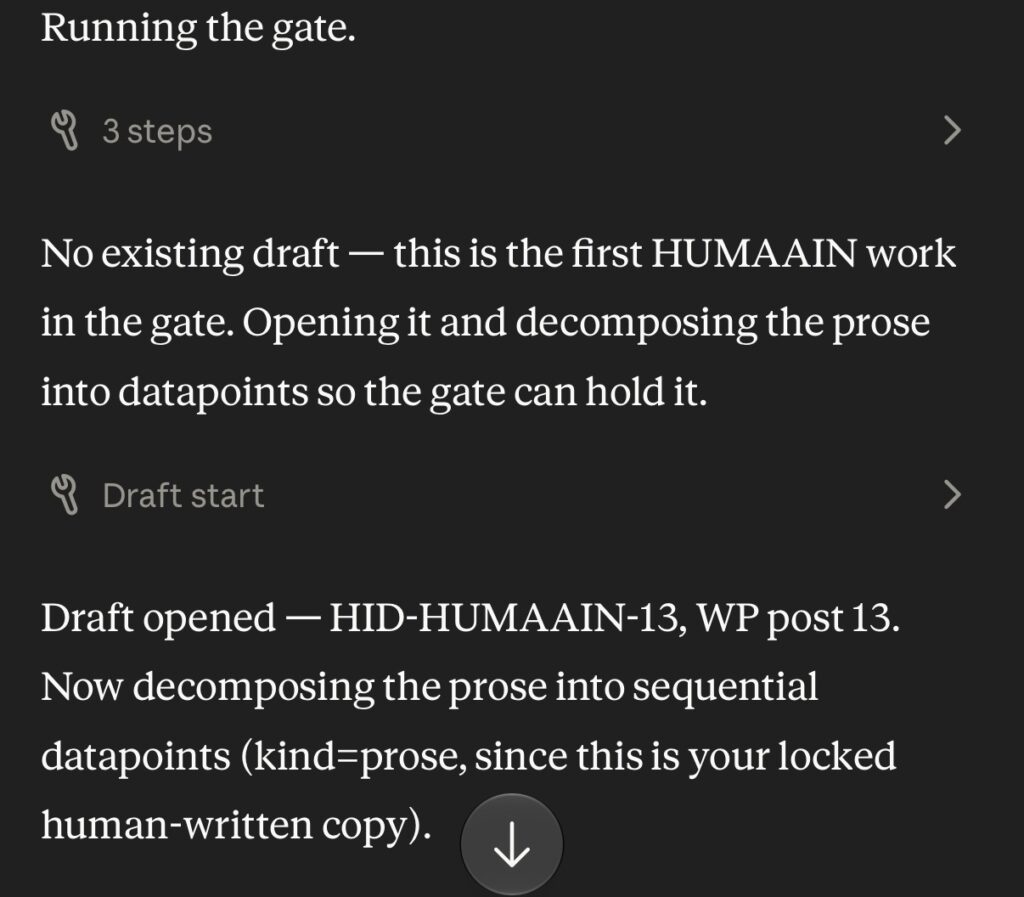
The Educator Module is my publishing dark horse. I don’t expect AI to do my research for me, but I do expect LLMs to be able to identify where I need to think about editorial defensibility. While it shouldn’t tell me what to write, it can tell me when a claim I make is weakly sourced. If it gets confused and triggers the wrong search, that’s a sign my writing isn’t clear enough, which means the engine functions as a writing enhancement tool for me.
Only once a claim is the best version of itself that it can be, in my own words, do I lock the prose and store that to be compiled at publish.
Then, the boring bits. SEO linking, headings, metadata, keywords, and Schema data for rich results.
Turns out, all of that can be stored on the database across writing sessions tied to that draft, along with all links for research, which proves useful for external linking.
It also turns out that can be submitted with a single MCP tool use, which advances the economical token use behind this approach.
What This Has Enabled Me to Do
Fundamentally, I’m able to let the prose meet the tech where it’s at now, and where it will be in the future.
By having the LLM recognise everything that could be structured data as structured data, I’m able to repurpose my robust prose into actionable content: web stories, infographics, and one pagers.
All human-designed, all human-authored, and compiled by the most advanced compiler we all have access to.
And I can do this on any device, in any chat.
But, here’s where we get to the current limitations.
SKILLmd is (Currently) Weak, MCP has (Currently) Low Permeation in Publishing
I don’t claim to have invented anything substantively new outside of an architectural approach that scales. I simply took a creative look at the currently available technology and found a way to make it work for me, a solo operator.
But, the technology is relatively primitive. However robust this framework is for me, enterprising this solution would require two things:
- Encrypted and secret SKILLmd file types, to prevent tamper and protect IP. There’s also an added security benefit that I won’t pretend to understand, only one that this very engine surfaced in the drafting research phase, and
- Wider adoption of the MCP protocol (see; I said it).
There would be additional concerns to address when those things happen, but I believe this system has proved the utility for LLMs in a scalable context, justifying the above as the next logical evolution.
Many of the flaws with how AI is used now are because it’s trying to replicate an output that was at a breaking point, technologically, anyway.
Constantly changing ranking algorithms caused an entire industry to pop up, and they make more than their fair share of money. One client at £1,000 a month would pay for the entire technical overhead, so 40 clients at £500 is why there are so many agencies that are all flourishing.
This is a Prototype of the Future
When the devs and Elon bots started talking about how AI is democratising creativity, they were wrong. LLMs, on the other hand? They have democratised one of the largest barriers to digital and future-proof publishing: optimisation.
Some might argue that’s a skill in and of itself, but “digital journalist” always felt like a stopgap in the evolution of the career.
My solution puts creativity back in the hands of humans and leaves the tech to the computers, which isn’t utopian but does have real utility now and for the future.